Every cloud provider publishes a shared responsibility model. The model is accurate enough as a legal boundary. It is often weak as an operating boundary.
The provider owns the platform. You own what you build on top of it. That sounds clear until the day your workload is unavailable while the provider remains technically within contract.
That is where the phrase starts to fail operationally.
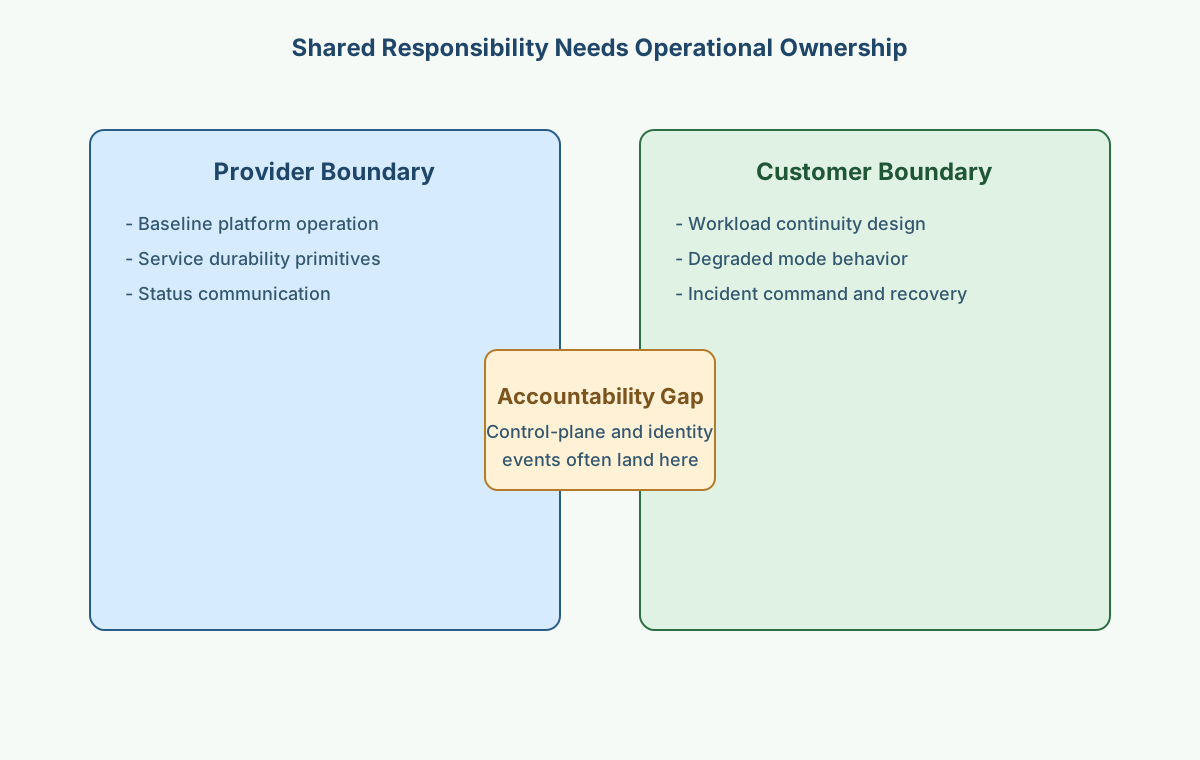
The real problem is not the model itself
The shared responsibility model is not wrong. The problem is how organizations use it.
Most teams treat it as a liability boundary instead of a design constraint. They hear that the provider manages the platform and quietly infer that the platform will absorb a class of failures their workload never actually rehearsed.
That is the beginning of the accountability vacuum.
What teams assume the cloud will save them from
Teams regularly assume the provider will carry more of the operational burden than reality supports:
- identity instability
- DNS and traffic routing issues
- control-plane impairment
- provider-side monitoring blind spots
- regional coordination failures
The provider may restore the platform eventually. That is not the same thing as protecting the customer experience in time.
Legal clarity versus operational survivability
A provider can be acting exactly inside the service contract while the customer still experiences a major business outage.
That distinction matters.
If the workload depends on one control-plane path, one identity assumption, or one regionally concentrated dependency chain, then the provider’s baseline resilience is only part of the story. The rest belongs to the customer architecture.
The question architecture reviews often skip
What happens if the provider is healthy enough to avoid credits, but your customers still cannot transact?
That one question exposes the gap between legal responsibility and operational accountability.
It pushes teams to model fallback behavior, manual intervention paths, degraded modes, and the actual blast radius of provider-side issues that do not look dramatic from the outside.
Practical model
| Layer | Provider role | Customer role | Common failure |
|---|---|---|---|
| infrastructure baseline | operate the service | design for workload continuity | baseline mistaken for end-user availability |
| control plane | keep management functions running | create break-glass fallback | no manual path exists |
| data plane | provide service durability and features | handle retries, idempotency, and recovery | app not designed for partial service loss |
| operations | publish status and recover platform | command incident and protect customers | nobody owns end-to-end outcome |
What to do this quarter
- Pick one critical workload.
- List three provider-side failures that could hurt customers even if the provider stayed inside contract.
- Add one manual or degraded fallback path.
- Record the result in an ADR or an existing architecture record.
Bottom line
Shared responsibility only becomes operationally useful when the customer side models the failure paths the contract language does not save them from.
Chapter bridge
Chapter 4 introduces the reliability equation that turns these ownership decisions into an explicit operating and financial model.