This chapter is the intellectual core of the book.
If the reader leaves with only one working mental model, it should be this one.
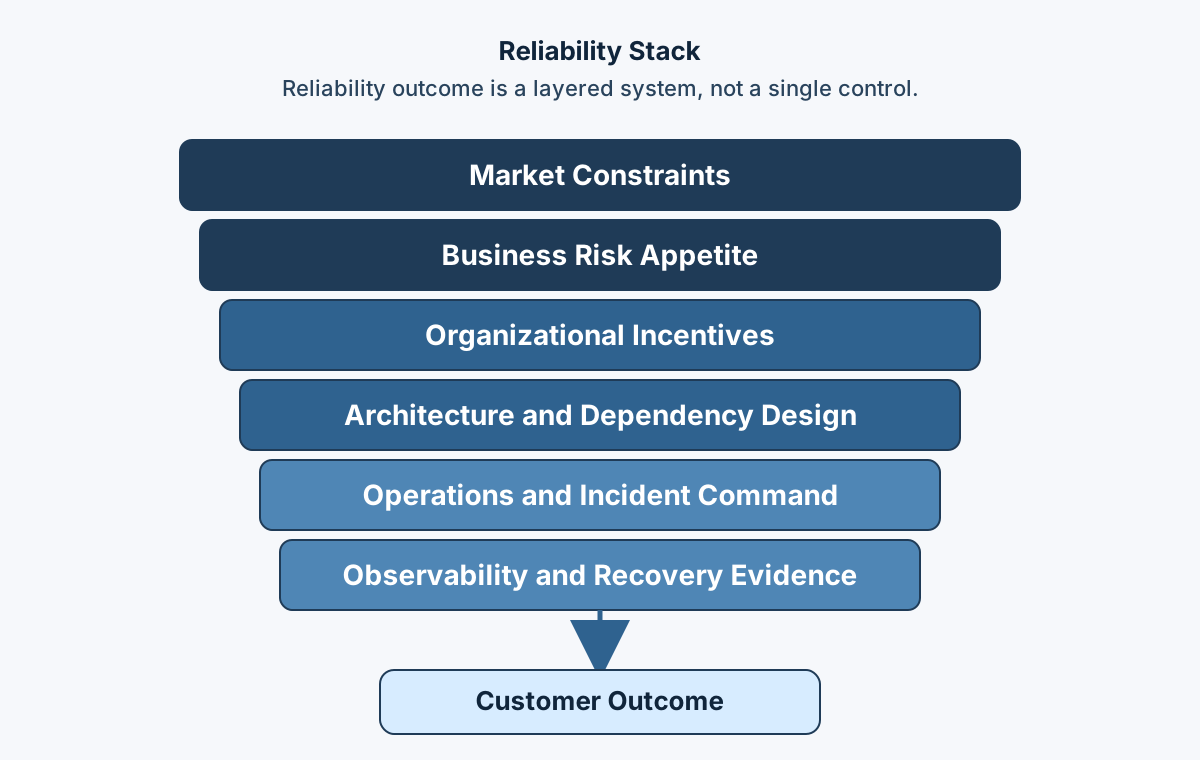
Reliability outcome = market constraints + business risk appetite + organizational incentives + architecture + operations + observability + supply-side capacity constraints.
If one layer weakens enough, the customer outcome degrades no matter how strong the other layers appear in isolation.
Unit of governance
The primary unit of reliability governance is the critical customer journey, not the individual service.
Service-level metrics still matter, but governance should center on whether a customer can complete a revenue or mission-critical workflow end to end.
This prevents fragmented accountability across microservices that each look healthy while the journey fails.
Control plane and data plane are separate reliability surfaces
Control plane availability and data plane availability are related, but not interchangeable.
A service can have healthy traffic-serving paths while control-plane paths for deployment, scaling, policy, or identity are impaired. The customer journey can still degrade when that state persists.
This is why governance should track both surfaces explicitly.
The stack matters because outages are layered
Most organizations analyze outages too close to the trigger.
They see a failed deployment or a regional dependency problem and stop there. The stack forces a more disciplined question: which layer allowed the customer outcome to degrade and which higher layer made that likely months earlier?
That is how architecture turns into governance instead of only postmortem vocabulary.
The recovery model most teams only partially use
Reliability is not just SLO.
It is also:
- RTO, the maximum acceptable recovery time
- RPO, the maximum acceptable data loss window
- BR, the business recovery curve after technical restoration
Most teams can say something vague about uptime. Fewer can state the recovery target with confidence. Fewer still can explain how long the business takes to normalize after the system is technically back.
That is why BR matters. A green dashboard does not mean trust, demand, or growth recovered at the same speed.
Time as a governing dimension
SLOs are time-bound statements. A 99.9% SLA over a year means you can afford roughly 8.76 hours of downtime. But that tolerance plays out over 365 days, not all at once.
The problem: time is compressed during failures. When you are in an incident, detection takes minutes, decision takes minutes, and recovery takes minutes. The total elapsed time during the incident is tiny compared to the annual window—yet it feels infinite.
This is why RTO (recovery time objective) is as important as SLO (availability target). Two services might both meet 99.9% availability, but one recovers in 15 minutes while the other takes 4 hours. Over a year, that time difference compounds across incidents into dramatically different business outcomes.
The financial model must account for time at three scales:
- Annual: error budget (how much total downtime is acceptable?)
- Incident: RTO (how quickly must the system be back?)
- Decision: how fast can humans detect and decide during degradation?
Error budget as a financial construct
Error budget is often introduced as an engineering management concept. It is more than that.
It is the tolerated interruption window the business is implicitly financing.
If leadership says a service is 99.9%, they are saying the business can absorb roughly 8.76 hours of availability loss per year. The important next question is whether the service economics, architecture, and operations actually support that claim.
When a Tier 1 service exceeds its monthly error budget, non-critical deployments pause until burn rate stabilizes under agreed thresholds.
That consequence is what turns error budget from a dashboard number into a governance control.
Decision hierarchy by tier
Conflicts between cost, speed, and reliability should be pre-resolved by policy.
| Tier | Decision hierarchy |
|---|---|
| Tier 1 | reliability, then cost, then speed |
| Tier 2 | reliability and cost in balance, then speed |
| Tier 3 | cost, then speed, then reliability enhancements |
If no hierarchy is defined, quarterly pressure will define one implicitly.
Failure domains make the model usable
Failure domains should be named explicitly:
- component
- zone
- region
- provider service
- control plane
- data plane
- third party
- organization
- economic and supply-side constraints
Once those are named, the model stops being abstract. Teams can decide which domains are funded, which are accepted, and which are still invisible.
Supply-side constraints matter as much as demand-side economics in enterprise environments. A multi-region design is only reliable if failover regions have service parity, SKU availability, quota headroom, and tested operational access when needed.
Practical tables
| Service tier | Typical SLO | Typical RTO | Typical RPO | Business meaning |
|---|---|---|---|---|
| Tier 3 | 99.5% to 99.9% | 4 to 24 hours | 24 hours | interruption is acceptable if recovery is orderly |
| Tier 2 | 99.9% to 99.95% | 1 to 4 hours | 1 to 4 hours | disruption is painful but survivable |
| Tier 1 | 99.95% to 99.99% | 15 minutes or less | 5 minutes or less | revenue and trust are directly exposed |
| Failure domain | Typical protection pattern |
|---|---|
| component | restart, replica, health probe |
| zone | cross-zone resilience |
| region | tested failover with capacity validation |
| control plane | manual override, break-glass path |
| data plane | graceful degradation on serving path |
| third party | degraded mode and fallback |
| organization | runbooks, backup operators, clear ownership |
| economic and supply-side constraints | quota runway, SKU parity checks, capacity reservation where applicable |
What to do this quarter
- Build the reliability stack for one core product.
- Name its SLO, RTO, RPO, and BR target explicitly.
- Identify the failure domain that is currently least priced and least governed.
- Make the error budget visible to both engineering and finance.
- Validate failover assumptions against current quota, SKU availability, and region readiness.
Reinforcing the principle
Recall: Reliability is not achieved at deployment. It is continuously negotiated between system design, incentives, and time.
This model shows all three in action. System design sets the failure domains and the stack. Incentives determine the tier and the decision hierarchy. Time constraints (SLO, RTO, RPO) determine what “negotiation” actually means operationally. They are inseparable.
Bottom line
This model exists to stop reliability from collapsing into isolated technical fixes. It turns survivability into a system that leadership, finance, architects, and operators can reason about together.
Chapter bridge
Chapter 5 pressure-tests this model against public provider incident patterns and status-page evidence.