Production rarely fails in clean binary ways.
One dependency slows down. One region sees elevated latency. One queue continues accepting writes while downstream effects trail for hours. Identity is not fully down, but token issuance is unreliable enough to break logins. Traffic management is not gone, but it is unstable enough to make the application appear unavailable.
That is why partial failure is the default cloud state.
It is also why control plane failures matter so much. A system can have healthy compute, healthy storage, and healthy data while still being unavailable in the only way the business cares about: customers cannot complete the journey they came for.
Why dashboards miss the most dangerous failures
Averages hide degradation well.
Leadership sees green dashboards. Customers see inconsistent behavior. One geography is slower. One provider integration is unstable. One thin but critical dependency path is collapsing while the global average still looks acceptable.
The problem is often not lack of telemetry. It is lack of correlation by customer journey and dependency path.
Time as a dimension of partial failure
A 10-second partial failure has different consequences than a 10-minute one, which has different consequences than a 1-hour one.
- 10 seconds: Retries often mask it. Customers might not notice if the application is designed for transient failures.
- 10 minutes: Queues back up. Cascading failures start. Retry storms amplify load. Customers begin giving up.
- 1 hour: Customer impact compounds. Trust erodes. Churn begins. The business impact exceeds the technical recovery cost.
Timeout and circuit-breaker tuning matters for this reason. Too long a timeout and partial failures look like hangs. Too short and legitimate slow paths fail. The right timeout is the one that stops the partial failure from becoming a customer-visible cascade.
The region is not only up or down
Many disaster recovery plans still assume a binary model: the region is healthy until the moment it is gone.
That model is wrong often enough to be dangerous.
Recent cloud incident patterns show a more painful middle state. The region still exists. Some workloads still answer. Health probes still pass. But a shared dependency inside the region, such as networking, identity, traffic management, maintenance activity, or the control plane itself, becomes impaired enough to block real customer work.
This pattern is the partial-region trap.
Your compute can be alive while token acquisition is unreliable. Your data can still be present while the control plane cannot create, update, or reroute what is needed. Your traffic manager can still send users into the degraded region because the failure does not look complete enough to trigger the expected automation.
Regional degradation exercises matter more than tidy full-outage tabletop drills for this reason. Full-region loss usually gives you a clean decision. Partial-region impairment forces a messier one: what should stay, what should fail over, and what should deliberately degrade in place.
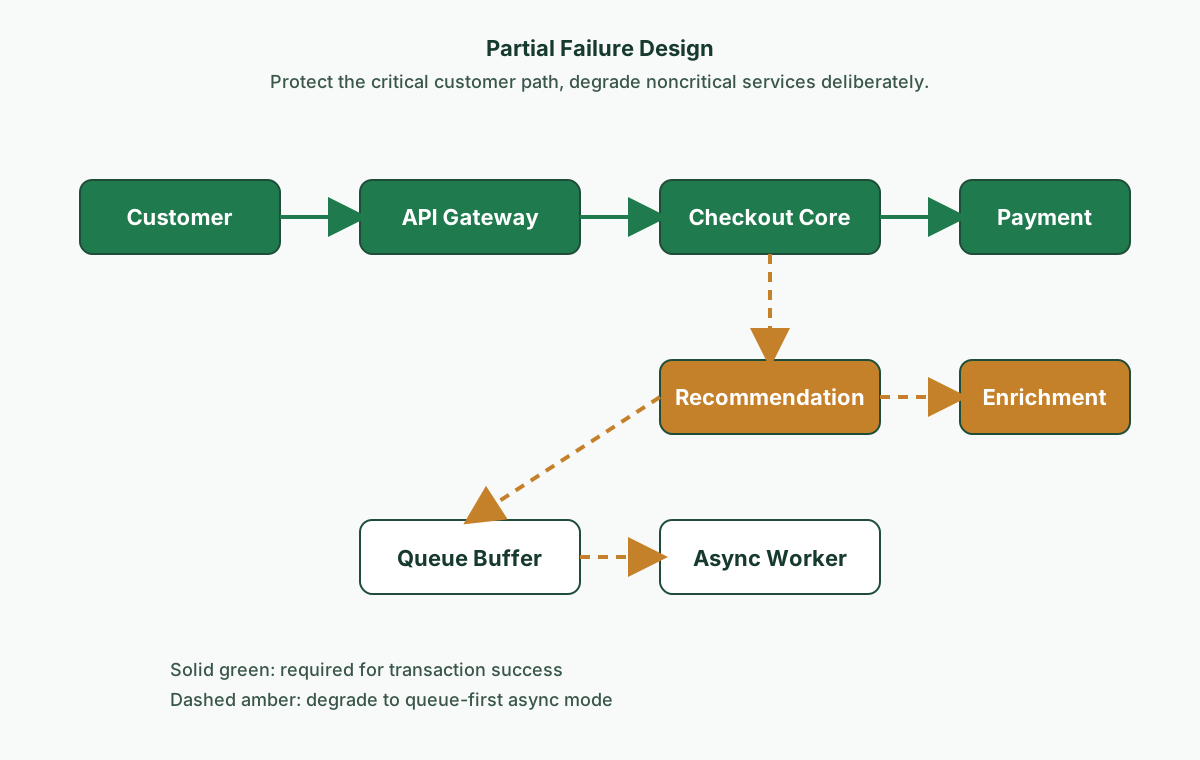
The most common design failure is coupling customer success to every dependency in the chain.
If recommendations can block checkout, if enrichment can block onboarding, or if one non-critical API can delay a core transaction, the architecture is too tightly coupled for the risk it carries.
Reliability begins by deciding what must succeed now, what can wait, and what can disappear temporarily without causing real business damage.
Control plane failures are not side issues
Control plane failures deserve separate treatment because they feel psychologically different from data-plane failures.
Teams understand storage loss. They understand a dead VM or a failed pod. They are often less prepared for:
- DNS or traffic-management instability
- certificate issues
- deployment orchestration problems
- configuration propagation failure
- identity and token-service impairment
These are especially dangerous because the application can appear healthy from the wrong angle while customers are still blocked.
Patterns that survive degraded conditions
The goal is not to eliminate all partial failure. The goal is to stop partial failure from cascading into a business outage.
The recurring patterns are familiar because they work:
- strict timeouts
- circuit breakers
- bulkheads
- queue-first buffering
- idempotent retries
- product-approved degraded modes
- manual fallbacks for critical control-plane impairment
Queues, retries, and autoscaling help only when the failure is truly brief and the bottleneck is understood. They do not rescue a design that keeps routing real customer work through a dependency path that is already unhealthy.
Practical checklist
For each Tier 1 service, verify these points:
- one degraded mode exists for at least one critical dependency
- non-critical dependencies cannot block the revenue path
- control-plane fallback path is documented
- regional degradation has been tested, not only full outage
- customer-facing communication path remains available if the primary platform path is unstable
What to do this quarter
- Run one regional degradation exercise.
- Identify one non-critical dependency that can still block a critical customer journey.
- Define a degraded mode with product leadership.
- Add one manual control-plane recovery path.
- Identify one selective failover decision that is harder than full regional failover and rehearse it.
Bottom line
Teams that assume failure is binary build brittle systems. Teams that assume degraded behavior is normal build systems that remain useful while the platform is imperfect.
Chapter bridge
Chapter 7 addresses the economic ceiling that appears when observability, redundancy, and operational overhead start competing for budget.