Reliability decisions do not fail only because teams misunderstand technology. They fail because organizations are forced to make trade-offs under pressure and usually do not frame those trade-offs honestly enough.
That is where this chapter lives.
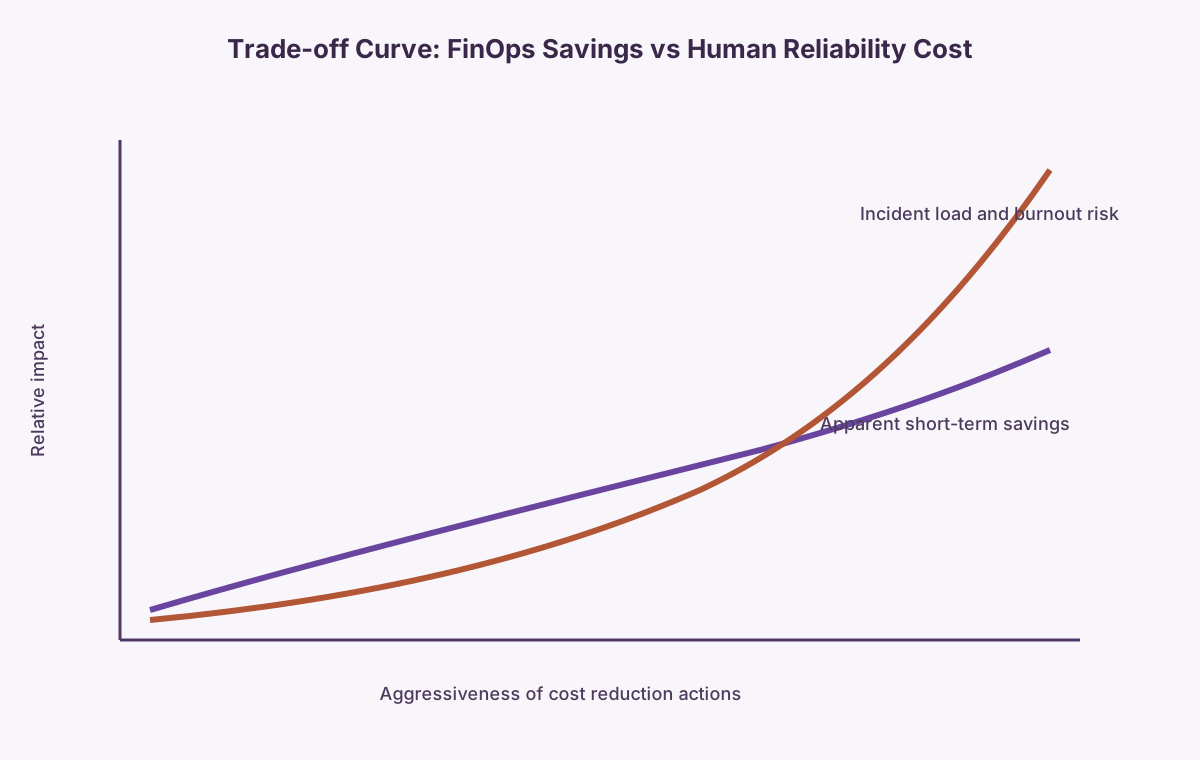
FinOps and SRE are often looking at the same number differently
FinOps sees low utilization and asks whether the spend is justified.
SRE sees headroom and asks what risk appears if that spend is removed.
Neither view is irrational. The failure happens when those views never meet in one explicit decision model.
That is how resilience headroom disappears while the cost optimization still looks reasonable in isolation.
On-call is not free reliability
Many organizations talk about pager duty as though it is a routine operational detail. It is not. It is part of the reliability architecture.
Every serious incident has a human cost:
- sleep loss
- slower decision-making the next day
- delayed roadmap work
- increased burnout and attrition risk
- knowledge concentration in the few people who keep surviving the hardest incidents
An organization that treats on-call coverage as a free fallback for weak design is building a system that spends people instead of engineering.
The quiet costs teams underprice
The most commonly underpriced elements are not the obvious infrastructure lines.
They are:
- manual rollback burden
- support surge during and after incidents
- longer diagnostics because data was cut for cost reasons
- the drag of half-recovered teams for days after a bad night
These do not appear cleanly in infrastructure dashboards. They still shape reliability economics.
Practical table
| What looks cheaper now | What often costs more later |
|---|---|
| smaller on-call rotation | slower response and higher burnout |
| shorter telemetry retention | weaker root-cause analysis |
| manual failover | longer outages and more variance |
| fewer rehearsals | more improvisation under pressure |
Time-based trade-offs
Every reliability trade-off involves time in three dimensions:
- Detection time: How quickly do you see problems? (depends on observability cost)
- Response time: How quickly can humans decide what to do? (depends on runbooks, clarity, authority)
- Recovery time: How quickly can you execute the fix or rollback? (depends on automation, process, testing)
When you cut observability cost, detection time rises. When you simplify runbooks, response time might fall but decision quality suffers. When you skip rehearsals, recovery time becomes unpredictable.
The uncomfortable part: You are always making these trade-offs. The question is whether you are making them consciously or by accident.
Reinforcing the principle
Recall: Reliability is not achieved at deployment. It is continuously negotiated between system design, incentives, and time.
This chapter shows what “continuously negotiated” actually means in practice. Every quarter, every incident review, and every cost optimization decision is a negotiation. The organizations that survive are the ones where the negotiation is explicit and governed.
- Price the on-call burden of one Tier 1 service.
- Review one recent cost optimization for hidden reliability consequences.
- Track one month of actionable versus non-actionable alerts.
- Ask what human cost the last two incidents created and where it is recorded.
Bottom line
If the service only remains reliable by exhausting the people who run it, the organization has built a temporary success condition, not a durable operating model.
Chapter bridge
Chapter 9 turns these trade-offs into governance artifacts so reliability choices stay explicit over time.