The Scene
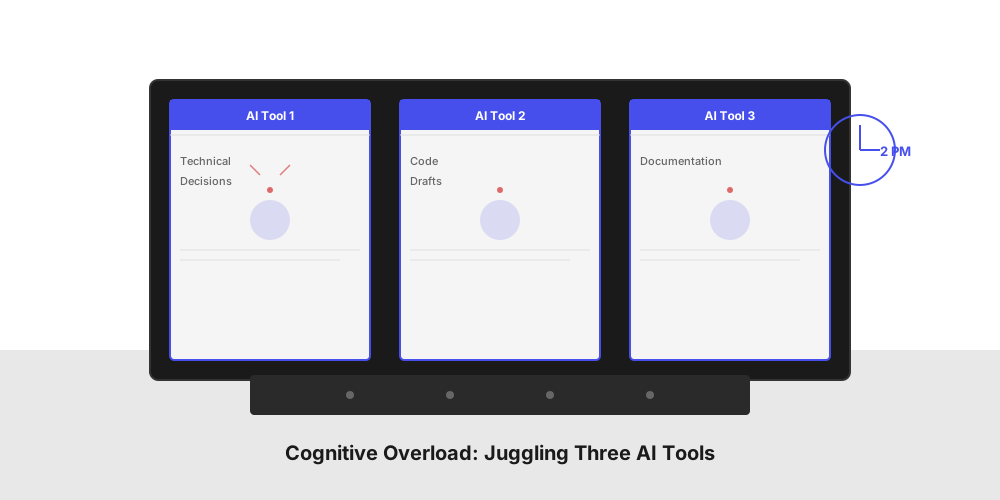
It’s 2 p.m., and the engineering manager has three AI tools open.
One is weighing technical decisions. Another is spitting out code drafts and summaries. A third is generating documentation. He keeps bouncing between them, double-checking every output, cross-referencing every recommendation, validating each suggestion against his domain expertise.
By 2 p.m., his brain feels like it has a dozen browser tabs open, all fighting for attention. He’s not physically tired. He’s cognitively fried.
What Actually Happened
The promise was simple: AI will reduce the burden of routine work. Workers will have more time for high-value work. Productivity increases.
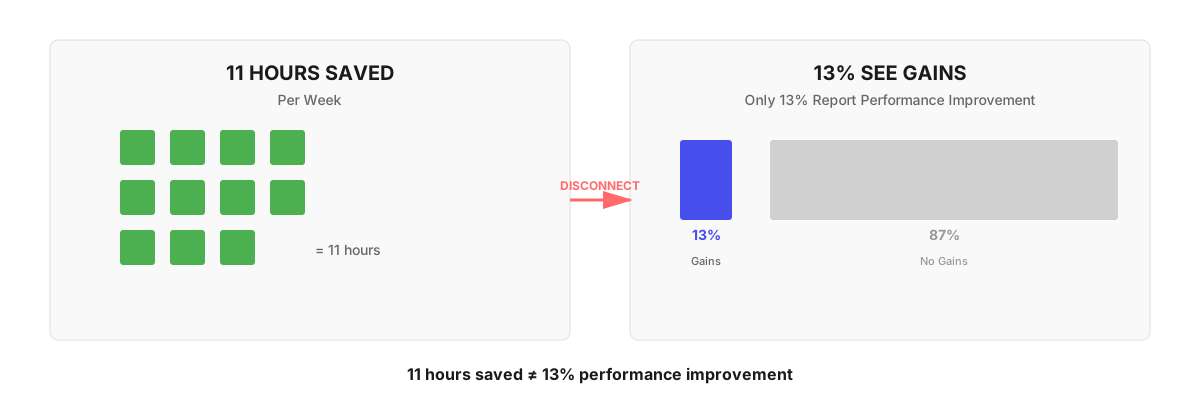
Here’s what actually happened: Workers report AI saves them 11 hours per week (6,000-worker study, US/UK/Australia). Yet only 13% of those organizations report meaningful performance gains. The time gets freed. The business doesn’t improve. Something’s absorbing those 11 hours.
So where are those 11 hours going?
Into botsitting.
Botsitting is the largely unrecognized, unbudgeted labor of making AI usable: feeding it missing context, checking its outputs, debugging its mistakes, rerunning prompts, and cleaning up confident-but-wrong answers. Workers now spend an average of 6.4 hours every week botsitting. That’s more than a full workday dedicated to supervising AI rather than doing the work.
AI didn’t eliminate work. It converted workers into supervisors.
Supervision is cognitively harder than execution.
Why Supervision Breaks Brains
Most organizations think AI brain fry is about tool complexity. It’s not.
The BCG research measured the full range of how workers engage with AI: number of tools used at once, whether AI replaces work or augments it, level of oversight required, and whether AI increased or decreased overall workload. The answer cuts against every productivity narrative ever marketed.
The most mentally taxing form of AI engagement was oversight.
Workers with high oversight demands expended 14% more mental effort, experienced 12% more mental fatigue, and reported 19% greater information overload than those with low oversight demands.
Here’s what defies intuition: when AI was used to replace routine tasks, burnout scores dropped 15%. Workers reported higher engagement and stronger connections with colleagues. Mental fatigue didn’t improve though. Oversight-heavy AI work drove more mental strain regardless of whether it reduced the drudge work.
This is the paradox that breaks the productivity narrative: You can reduce burnout by automating routine work, but you can’t reduce mental fatigue. The oversight burden creates a new, harder form of cognitive load.
The 3-Tool Cliff
Okay, here’s where the data gets precise enough to be actionable.
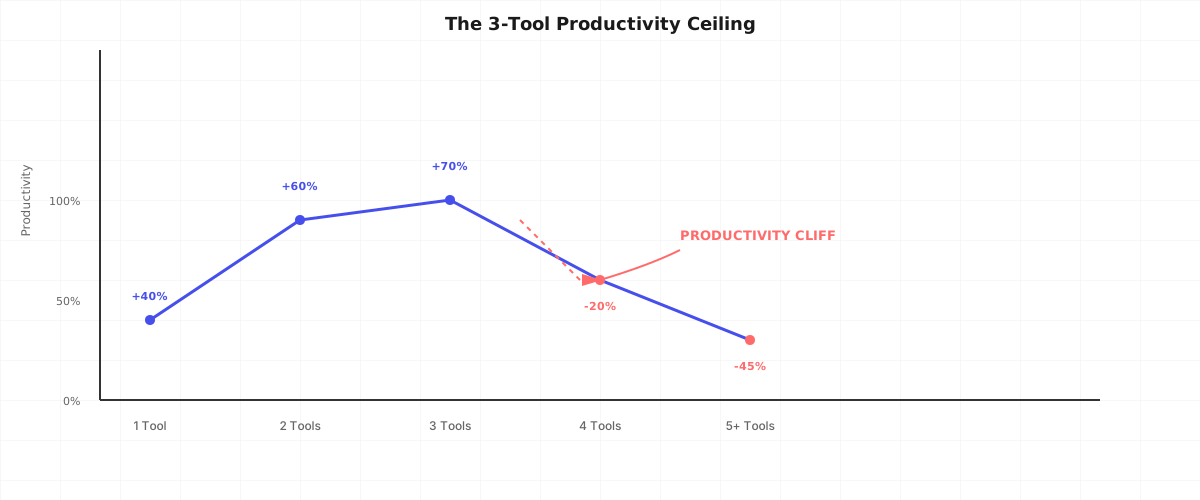
One AI tool? Productivity boost. Two tools? Productivity still increases, though more slowly. Three tools? Gains flatten. Four or more? Productivity declines.
This isn’t philosophy. It’s measurable.
Why does this happen? The answer lives in cognitive load theory, a framework developed by psychologist John Sweller in 1988. Working memory has a hard ceiling. When the volume of information we’re asked to process exceeds that ceiling, performance doesn’t just dip. It collapses. Accuracy drops. Creativity stalls. Errors multiply. The brain wasn’t built to monitor multiple AI agents, evaluate their outputs, and make strategic decisions simultaneously.
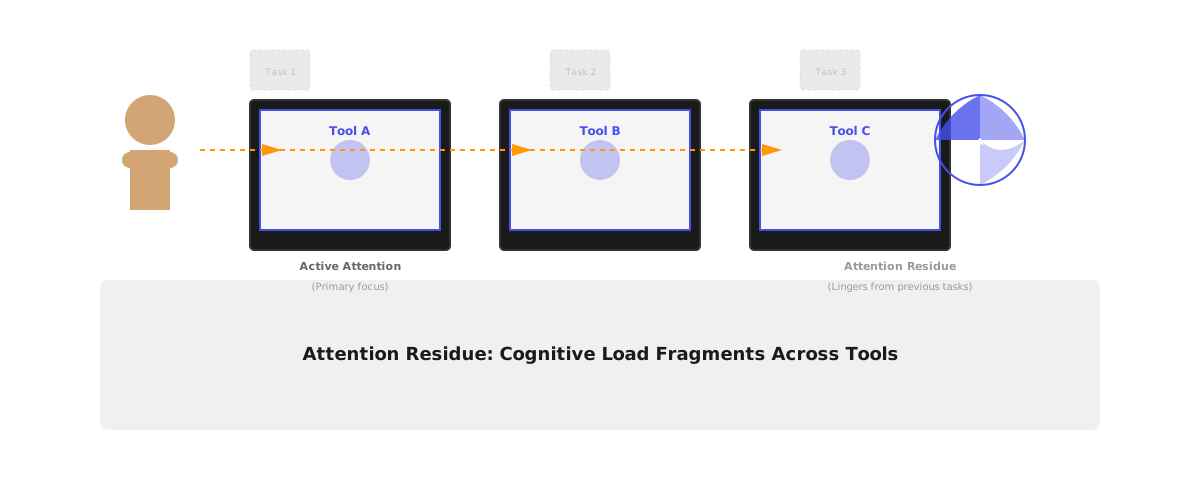
There’s another layer. Sophie Leroy’s research on “attention residue” (2009) shows that when people shift from one task to another, part of their attention literally stays behind. It clings to the unfinished task, quietly consuming processing power. This explains the BCG productivity cliff perfectly.
Each additional tool isn’t just one more thing to manage. It’s one more source of attention residue. One more drain on the finite attention you need for work that actually matters.
The data is stark: organizations deployed an average of 7 AI tools (up from 2 three years ago). 83% use 6 or more. The productivity sweet spot exists: 7-10% of work hours in AI tools correlates with peak productivity (95%). But almost no one operates there. Only 3% of users hit that range. The majority (57%) spend less than 1% of time in AI tools. And among the heavy users? Productivity declines.
The Decision Fatigue Tax
AI increases decision volume. It accelerates decision speed. And it creates decision overload.
When you’re supervising AI, you’re making more decisions per hour than you were before. Not because you’re thinking faster. Because the tools are generating more options, more edge cases, more “wait, does this look right to you?” moments.
Research on decision fatigue shows this takes a toll: judgment degrades with every decision. Brain-fried workers show 33% more decision fatigue, score 11% higher on minor errors, and 39% higher on major errors. The compounding effect is real. Suboptimal decisions at scale cost organizations measurably. For a $5B firm, that’s roughly $150M annually. A 33% increase in decision fatigue isn’t a rounding error.
The problem isn’t that you’re making bigger decisions. It’s that you’re making more decisions. At lower quality. While already cognitively overloaded from oversight work.
The Psychological Layer That Nobody Talks About
Most research on AI adoption focuses on the mechanics: cognitive load, attention, decision-making. SVA Consulting’s analysis of client engagements surfaced something deeper—something that surveys miss entirely.
There’s a quiet erosion of professional confidence.
Employees describe feeling guilty for not producing more after AI “saved them time,” as if the freed-up hours created a debt they now owe. They feel uneasy presenting AI-assisted work, unsure how much credit to claim and how much to disclaim.
Some mourn the craft skills that used to define their value: the careful research process, the editorial instinct, the analytical rigor that took years to develop and now gets compressed into a prompt.
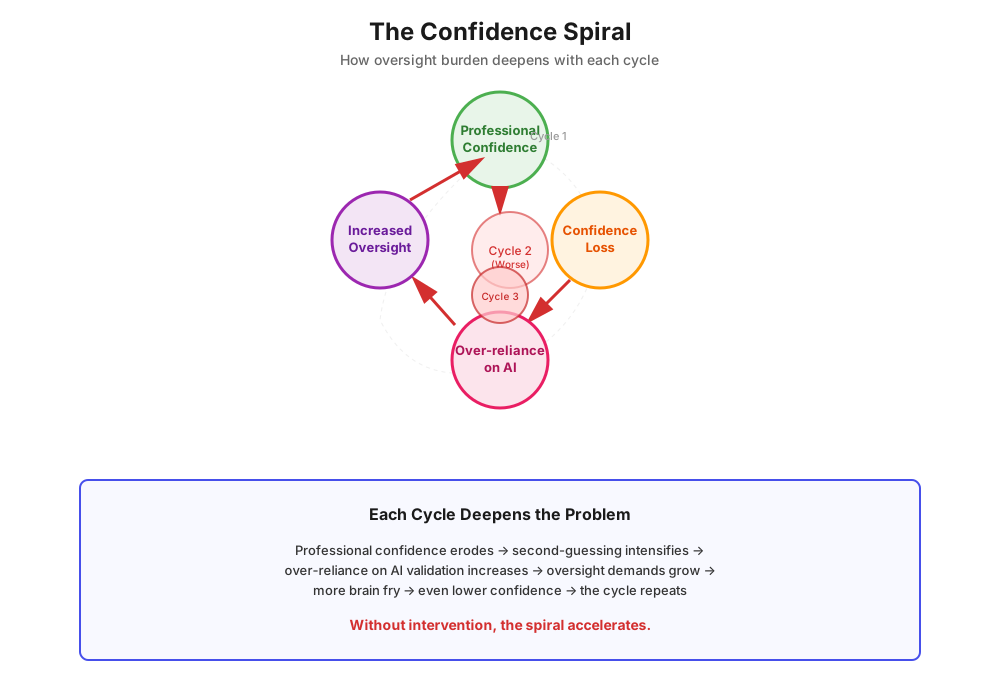
These aren’t just emotional responses. They’re signals of a feedback loop. Confidence loss leads to second-guessing. Second-guessing leads to over-reliance on AI validation. Over-reliance leads to more oversight demands. More oversight means more brain fry. More brain fry means more confidence loss.
An employee who doubts their own judgment is an employee who:
- Second-guesses decisions
- Over-relies on AI validation loops
- Ironically increases the very oversight load that causes brain fry
This emotional undertow compounds everything the BCG study measured. It’s not often discussed because it’s harder to quantify than decision fatigue. But it matters for business outcomes.
40 Years of Warnings. We Ignored Them All.
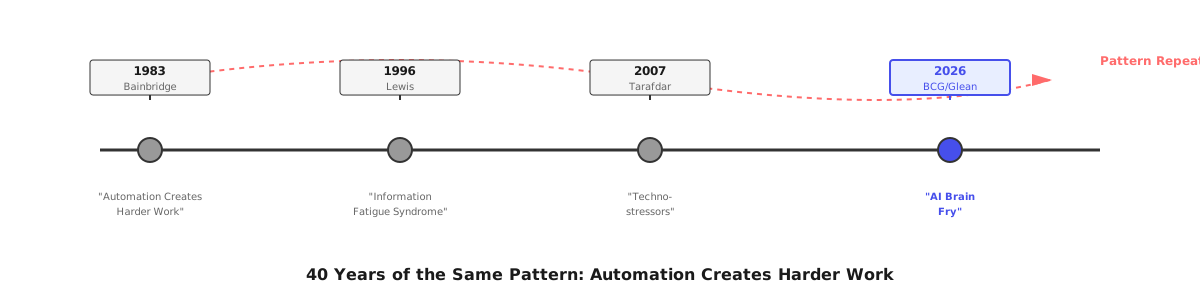
Lisanne Bainbridge published “Ironies of Automation” in 1983. She was studying air traffic control, power plants, and other safety-critical domains where automation was supposed to make work easier.
It didn’t.
Automation didn’t eliminate operators. It changed their role—and made it cognitively harder. Operators became monitors. Monitoring is exhausting. And routine task mastery atrophied. When automation failed (and it always does), operators were less equipped to handle it.
For 40 years, we’ve watched this pattern repeat:
1983: Bainbridge warns that automation creates harder cognitive work, not easier
1996: David Lewis coins “Information Fatigue Syndrome” after surveying 1,300 business people. Findings:
- 67% reported information overload stress damaged personal relationships and increased tension with colleagues
- 40% felt important decisions were delayed; excess information hampered their ability to make choices
- 1/3 suffered health problems directly attributed to information overload stress
Lewis described this as a primitive “fight-flight” response: when people are overloaded with information they need to make critical decisions, the body enters hyperarousal. The brain panics. Discernment fails. “Information stress sets in when people have to work against the clock, when major consequences will flow from their decision, or when they feel at a disadvantage because they still think they do not have all the facts they need.”
2007: Tarafdar and Ragu-Nathan formalize five “technostressors” that emerge when technology outpaces human capacity: techno-overload, techno-complexity, techno-invasion, techno-insecurity, and techno-uncertainty. AI brain fry maps onto at least three of them. The difference is the speed and scale at which AI amplifies them.
2026: BCG measures what this looks like in practice. We have the numbers. We have the framework. We have decades of warning.
Organizations are deploying 7+ AI tools per employee anyway.
Retention Risk Concentrates Among Your Best People
Here’s where this becomes a business problem that can’t be ignored.
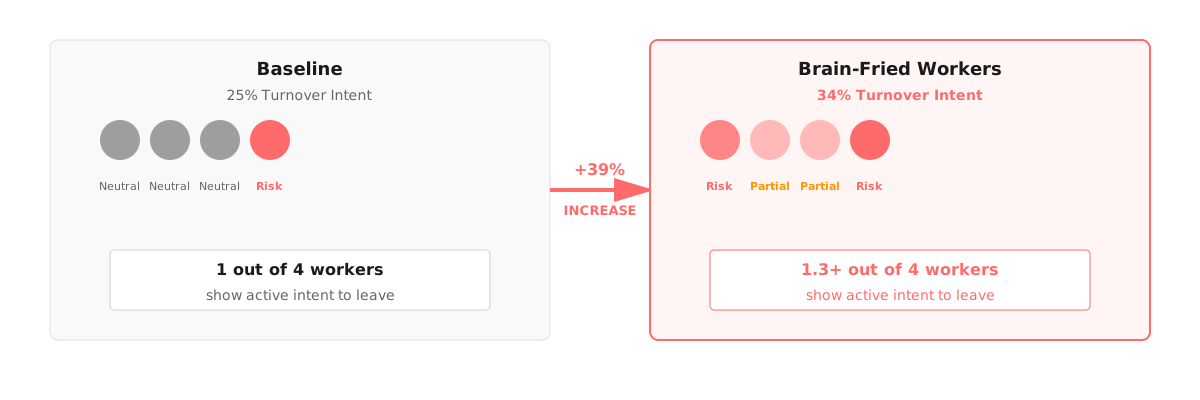
34% of workers experiencing AI brain fry show active intent to leave their jobs. Compare this to 25% baseline. That’s a 39% increase in turnover risk, concentrated among the employees who are using AI most intensively.
These are your high performers. The people organizations counted on most.
The pattern is clear in workforce data: disengagement risk jumped 23% (from 19% to 23% in a single year) for AI-heavy users. This is different from burnout. Burnout is exhaustion. Disengagement is “I’m being underutilized” or “I’m not trusted with real work.” Organizations invested heavily in tools that freed up time. They didn’t invest in what comes next. The capacity sits unused. The best people get restless.
The burnout crisis has eased. The alignment crisis is just beginning.
The Metrics Trap: How Organizations Measure Their Way Into Brain Fry
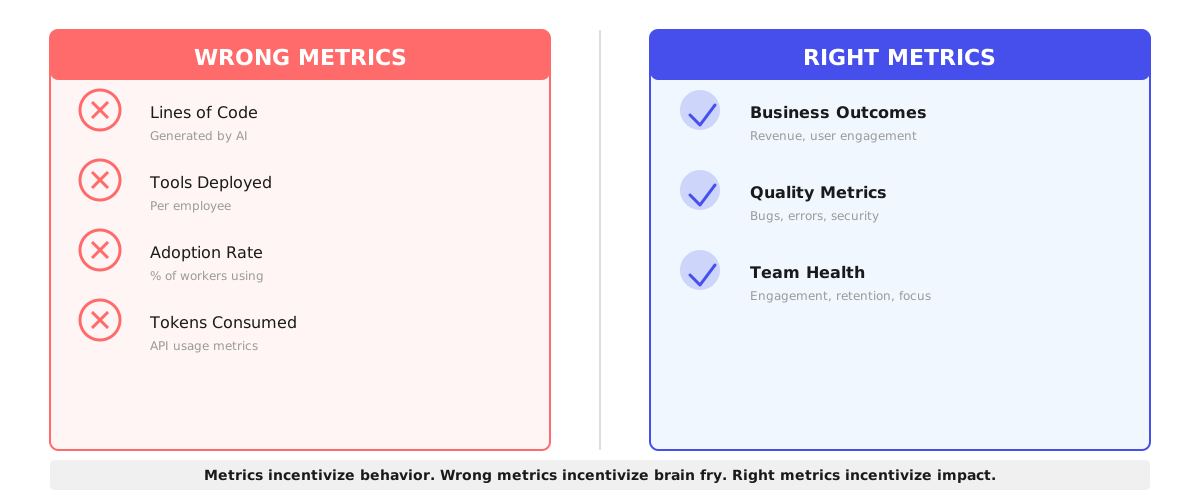
Organizations typically measure AI adoption by:
- Lines of code generated by AI
- Number of AI tools deployed
- Adoption rate
- Tokens consumed
All of these metrics incentivize exactly the kind of use that causes brain fry.
Some organizations now measure “lines of code generated by AI” as a success metric. This is a trap. You can optimize for line count without optimizing for anything that matters. An engineer who pumps out 500 lines of mediocre, oversight-heavy generated code doesn’t move the needle. But the metric says they do. So they keep doing it. The oversight load grows. Brain fry intensifies.
The real problem: 50% of organizations don’t measure the impact of AI at all. They measure adoption. They measure volume. They rarely measure what actually changed in the business. This gap between “we deployed AI” and “we understand what AI is doing” is where brain fry takes hold. You can’t optimize what you don’t measure. And most organizations aren’t measuring the right things.
The right metrics:
- Business outcomes (revenue, user engagement, etc.)
- Quality (bugs, performance, security issues)
- Team health (engagement, retention, focus time)
And critically: don’t backfill work when AI automates it. When someone’s AI tool saves them 3 hours, that’s not a workload expansion signal. It’s a growth opportunity. Treat it that way.
Training Misses the Mark (And Why)
Employees say they’d use AI more if training were better.¹ Organizations hear this and build training programs.
This sounds like a training problem. It’s not.
The gap isn’t about prompting. It’s about thinking. Meta-skills like problem framing, analysis planning, and strategic prioritization are what separate productive AI use from cognitive overload. The meta-skill is: knowing when and how to engage AI rather than defaulting to it for everything.
You can’t train someone out of a cognitive load problem. You can only redesign the work.
How to Actually Fix This
The good news: brain fry isn’t inevitable. It’s preventable. It’s fixable. But it requires design choices, not tool choices or training programs.
Lever 1: Span of Oversight
Organizations set “spans of control” for managers (typically 6-8 direct reports). Why not “spans of oversight” for AI?
The data says: 3 tools is the productivity ceiling.
- Audit how many AI tools each team member is expected to monitor simultaneously
- Set explicit boundaries
- Embed AI into shared workflows rather than stacking it on individual contributors

When AI is embedded in shared workflows (handled as a team responsibility), cognitive burden drops measurably.
Lever 2: Decision-Making Skills, Not Just AI Usage Skills
Train people to think strategically about when and why to use AI:
- Problem framing: “What problem are we actually solving?”
- Tool selection: “Which AI tool fits this?”
- Output assessment: “Does this actually solve the problem?”
These meta-skills are what distinguish productive AI adoption from cognitive overload.
Lever 3: Metrics From Activity to Impact
Stop measuring:
- Lines of code generated by AI
- Tokens consumed
- Number of tools deployed
- AI adoption rate
Start measuring:
- Business outcomes
- Quality (bugs, errors, security)
- Team health (engagement, retention, focus time)
And crucially: when work gets automated, don’t backfill it as punishment. Recognize the freed-up cognitive capacity as a growth signal.
The Bainbridge Echo: History Doesn’t Repeat, But It Rhymes
Air traffic control: automation created monitoring work that’s harder than the original job. Operators deskilled. When automation failed, they were less equipped to fix it.
Power plants: same pattern. Control rooms got quieter, but operator attention demand increased.
Medicine: Electronic health records were supposed to reduce paperwork. Instead, they created charting overload. Physicians spend more time on data entry than patients.
In every case, automation didn’t eliminate work. It reshaped it into a form that’s cognitively harder.
With AI, the same thing is happening. Just at much higher velocity and much larger scale.
The Real Question
This isn’t about whether AI is good or bad.
It’s about whether human supervisory capacity is infinite.
It isn’t.
Bainbridge knew it in 1983. Lewis documented it in 1996. Tarafdar formalized it in 2007. BCG measured it in 2026. Glean and Freshworks confirmed it this year.
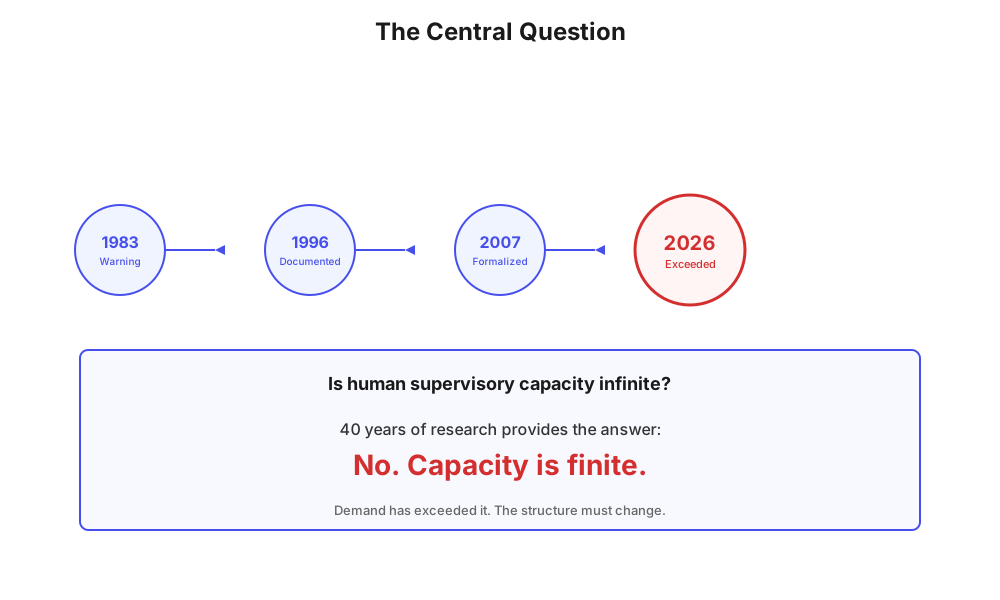
The question is no longer “Can AI help?” The real question is “At what point does the supervision work exceed what human brains can actually do?”
The answer, according to 40 years of research, is simple. Much lower than organizations think.
Organizations that design around this—setting span-of-oversight limits, measuring quality instead of adoption, investing in governance as serious infrastructure—will keep their best people and get far more from AI than organizations that keep pouring tools into the same broken structure and hoping it works this time.
The ones that get fried will blame the people.
But the problem was always the design.
The productivity gains from AI don’t scale indefinitely. Human supervisory capacity is finite.
The question now is whether your organization will acknowledge that—or whether it will keep expecting different results from what hasn’t worked for four decades.
Sources & Further Reading
This article builds on research across four decades:
- Bainbridge, L. (1983). “Ironies of Automation.” Automatica, 19(6). On how automation creates harder cognitive work.
- Lewis, D. (1996). “Information Overload.” Financial Times. The original framing of information fatigue syndrome.
- Tarafdar, M., et al. (2007). “The Impact of Technostress on Role Stress and Productivity.” Journal of Management Information Systems. Five dimensions of technology stress.
- Baumeister, R. F. (2006-2018). Research on ego depletion and decision fatigue. How cognitive capacity is finite and gets depleted.
- Leroy, S. (2009). “Why Time Flies When We’re Having Fun.” Journal of Neuroscience. Attention residue when switching tasks.
- 2026 Work AI Index. Glean, surveying 6,000 workers on AI adoption and outcomes.
- BCG research on AI Brain Fry (2026). Decision-making burden, mental fatigue, and supervision demands.
The pattern is consistent across research: automation doesn’t eliminate work. It converts workers into supervisors. And supervisory capacity is finite.