Most reliability material treats architecture as the primary constraint and tooling as a supporting concern. Real enterprises often live the reverse.
They know what patterns would improve reliability. They just cannot afford to observe, validate, and sustain those patterns at scale without hard trade-offs.
This chapter matters for one reason.
The reliability cost ceiling
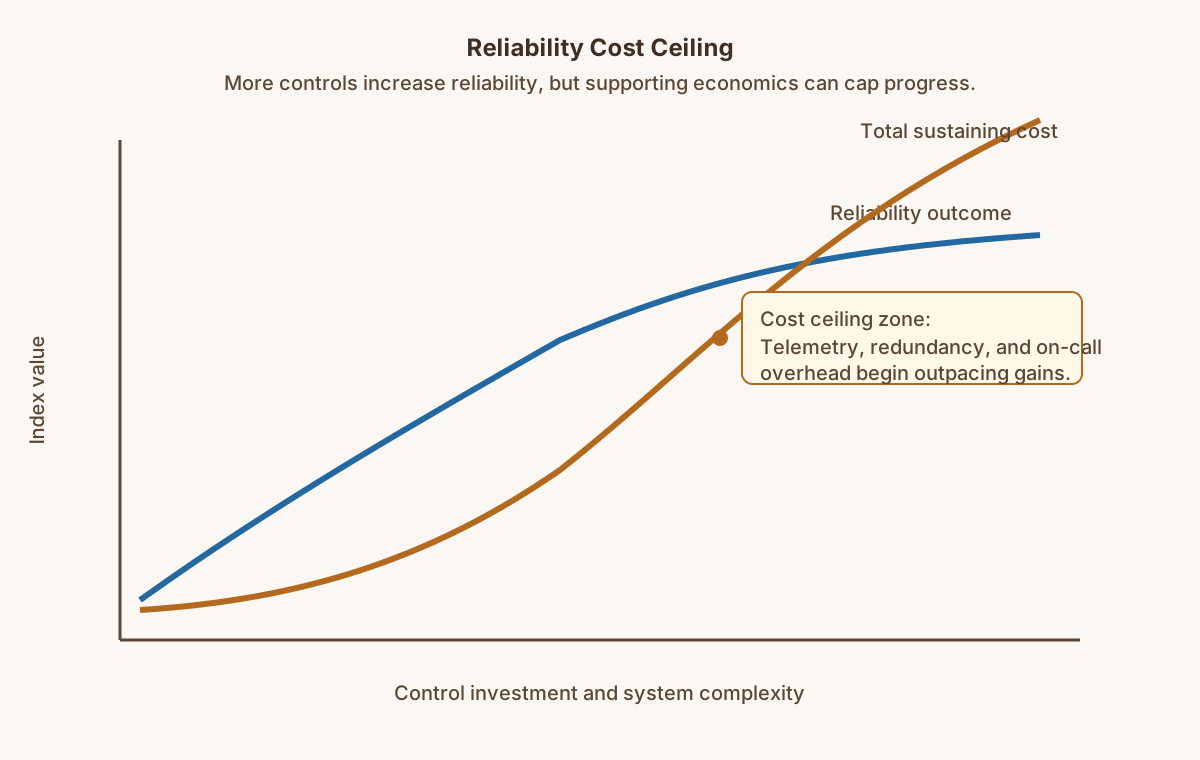
Reliability does not improve forever in a smooth line as long as the architecture is technically possible. It eventually reaches an economic ceiling created by the cost of visibility, redundancy, and operational overhead.
At small scale, teams can keep broad retention, add logging generously, and carry extra headroom without much debate. At larger scale, the supporting systems become their own budget fight.
The ceiling appears here. It is where second-order costs become more decisive than first-order design.
The observability loop
The most important paradox in this chapter is simple:
- better reliability requires better visibility
- better visibility creates more telemetry
- more telemetry increases storage, indexing, and query cost
- cost pressure cuts retention or sampling quality
- reduced visibility weakens future incident diagnosis
It is not a tooling complaint. It is a closed economic loop that quietly degrades reliability when cost pressure wins without enough care.
Time as a cost dimension
The cost of observability includes not just storage and computation, but the speed at which you can detect problems.
Faster detection requires:
- higher-fidelity instrumentation (more data)
- lower sampling rates (more storage)
- faster indexing (more computation)
- real-time alerting (more resources)
Budget constraints often manifest as trade-offs here. You cannot afford to index every trace at full fidelity, so you sample. Sampling improves cost but degrades your ability to detect rare failures. A failure that affects 0.1% of requests might be invisible if your sampling rate is only 1%.
This creates a hidden time cost: when you detect problems slowly, your detection-to-decision-to-recovery window expands, which compresses your error budget faster than the same failure would if detected quickly.
Redundancy also becomes more expensive faster than many leaders expect.
Moving from single region to multi-zone is usually manageable.
Moving from multi-zone to multi-region changes the operating model much more sharply:
- replication cost rises
- coordination cost rises
- testing cost rises
- data consistency questions get harder
- failover and failback become rehearsed operations rather than comforting diagrams
Many companies stop around 99.9% to 99.95% for this reason. It is often not indifference. It is the point where the economics become harder to justify than the architecture itself.
Reliability efficiency
The more useful question is not only “How reliable are we?” It is “How much reliability are we getting per dollar, per engineer, and per unit of complexity?”
This matters because two companies can make very different but rational decisions.
One may fund 99.99% because the revenue path is concentrated and outage loss is immediate.
Another may fund 99.95% because the cost of the extra nine is commercially harder to defend than the improvement in risk.
The better decision is the one that matches business reality without hiding the cost of keeping the proof.
Ceiling decision threshold
Reliability investment should stop scaling when the next increment no longer clears an economic test.
Use this rule:
- if cost per additional 0.01% availability is greater than expected loss reduction, stop scaling and document the ceiling decision in an ADR
This keeps maturity work economically disciplined instead of aspirational.
Practical model
| Reliability move | Hidden scaling cost |
|---|---|
| full tracing | cardinality, query, retention cost |
| multi-zone | capacity duplication and coordination |
| multi-region | replication, egress, failover testing |
| heavier alert coverage | tuning overhead and operator noise |
| more drills | time, coordination, and opportunity cost |
Cloud-specific reliability cost drivers
The cost table above captures category-level view. Enterprise reliability programs frequently underestimate five specific cloud cost drivers until they appear in billing.
Cross-region data transfer and egress
Moving data between regions is not free. In most cloud providers, data that crosses a regional boundary incurs egress charges regardless of whether it is for replication, backup, or synchronous write paths.
For a multi-region active-passive architecture with synchronous replication, every write is charged twice: the primary write and the replication egress. At high write volume, this cost becomes significant before the secondary region is ever actually used.
The trap. Teams design multi-region architecture based on compute and storage cost, then discover egress cost in production billing. A multi-region design that doubles replication egress at scale can increase infrastructure cost by 20 to 40 percent depending on the data transfer rate.
What to do. Model egress cost explicitly when comparing single-region-with-zones against multi-region. Include replication, backup, and cross-region API call volume in the model before committing to the architecture.
Storage replication tiering
Redundant storage across zones or regions is not uniformly priced. Zone-redundant storage (ZRS) costs more than locally redundant storage (LRS). Geo-redundant storage (GRS) costs more than ZRS. Geo-zone-redundant storage (GZRS) costs more than GRS.
The delta is not trivial for high-volume storage. A workload that stores 100 TB of telemetry with GRS replication enabled pays significantly more than the same workload with LRS. Most teams default to the most resilient option without auditing whether the workload’s SLO actually requires it.
What to do. Classify storage by tier. Tier 1 data (transactional, compliance-required) justifies GZRS or GRS. Tier 3 data (telemetry, debug logs, non-critical exports) can use LRS and accept the data loss risk in exchange for cost reduction. Document the decision in an ADR.
Control plane throttling and quota
Cloud control planes enforce rate limits on management API calls. When automation (infrastructure-as-code, auto-scaling, deployment pipelines) exceeds these limits, operations queue or fail.
This is not a theoretical concern. Large-scale deployments during incident response, rapid scale-out events, and chaos engineering runs that create and destroy many resources simultaneously regularly hit control plane throttle limits.
The reliability consequence. Automated recovery that depends on rapid resource creation can be throttled at exactly the moment it is needed. A scale-out triggered by a traffic spike may queue for minutes because the control plane is rate-limited.
What to do. Test control plane call rates under your worst-case recovery scenarios. Know the limits for your subscription tier. If automation exceeds limits in testing, adjust the recovery procedure or request a quota increase proactively rather than during an incident.
Reserved capacity versus on-demand cost
On-demand pricing is the baseline. Reserved instances or committed-use discounts reduce cost by 30 to 60 percent depending on term and provider.
The reliability cost is that reserved capacity locks in a resource configuration. If your architecture changes in response to a reliability incident (different VM SKU, different region, different database tier), the reservation may not apply or may require exchange at reduced value.
The tradeoff. Teams that reserve aggressively for cost efficiency sometimes find they cannot change architecture quickly because the sunk cost of reservations creates organizational pressure to preserve the existing configuration rather than optimize for the failure.
What to do. Reserve the steady-state baseline. Keep scale-out capacity on demand. Reserve for stable Tier 1 workloads. Avoid reserving for experimental or rapidly-evolving architecture. Document reservations and their expiry dates in the architecture decision record.
Observability ingestion and retention at scale
Log Analytics, CloudWatch, and equivalent services price on ingestion volume and retention duration. A reliability incident that generates heavy logging creates a billing spike at the exact moment the system is already under stress.
The common failure. Teams discover during a major incident that their verbose logging, which was generating minimal cost during normal operations, is now producing 10x normal ingestion volume and will trigger a budget alert before the incident is resolved.
What to do. Define SLI-critical logs that must be retained at full fidelity. Sample or compress everything else. Set retention policies explicitly by tier. Know what a major incident costs in observability billing before it happens, not while it is happening.
SLI, SLO, and SLA: What you are actually measuring
All this observability cost serves one purpose: to measure what you control and communicate what you promise.
Three terms, one hierarchy.
SLA — Service Level Agreement. This is the promise you make to customers. When you say “99.9% uptime,” the SLA is the contractual commitment. SLAs are external. Most organizations have no SLA defined at all, or copy their cloud provider’s SLA as if it applies to their product directly.
SLO — Service Level Objective. This is the internal target you set for your own reliability. It is usually lower than any SLA you might make, because your application depends on infrastructure you do not control. If your cloud provider commits 99.95%, and your payment processor commits 99.9%, your SLO must account for the combined risk. A reasonable SLO might be 99.5%, leaving margin for degradation you cannot prevent.
SLI — Service Level Indicator. This is the quantitative measurement that tells you whether you are meeting the SLO. An SLI must measure what your customer actually experiences, not what your infrastructure reports. “The provider says it was up” is not an SLI. “Customers completed 99.5% of checkout transactions without error or timeout” is an SLI.
The measurement gap
Cloud vendors provide SLAs. They almost never provide their own SLOs (internal targets) or useful SLIs.
A vendor says: “We guarantee 99.95% uptime for this service tier.”
The vendor does not say: “Our internal target is 99.98% with this specific SLI definition.”
The vendor does not publish: “Successful API calls / eligible API calls, excluding known maintenance windows.”
This creates a dangerous assumption: that the vendor’s SLA is a reasonable target for your product. It is not.
Your product depends on a cloud provider, plus your application code, plus your database, plus third-party APIs, plus your payment processor. Each adds latency and risk. If each layer is 99.9%, the combined availability is roughly 99.0%. That is the ceiling before your code even contributes.
This is why SLI design is not optional. Without a clear SLI, you cannot distinguish between:
- infrastructure failures you have no control over
- application failures you do control
- customer experience failures caused by dependencies you chose
The cost ceiling revisited
The observability cost ceiling exists because teams cannot measure everything at full fidelity forever.
Measurement priority becomes obvious once you define your SLI.
If your SLI is “successful checkouts / attempted checkouts,” then you must have:
- complete transaction logging (non-negotiable)
- retention long enough to diagnose multi-hour incidents (30+ days minimum for Tier 1)
- cardinality on payment processor latency (because that is a dependency)
- alerting on SLI breach, not on infrastructure metrics
Other observability can be sampled, truncated, or archived cheaply. SLI measurement cannot.
You make the cost ceiling defensible this way instead of arbitrary. You are not cutting observability to save money generally. You are concentrating spend on measurement that directly guards the SLI.
SLA pricing must follow SLI design
Most SaaS companies offer tiered pricing but have no SLA tiers to back it up. They charge more for “professional” or “enterprise” but promise the same uptime to everyone.
This breaks the economic model from Chapter 12. You cannot price reliability you cannot measure separately by tier.
If you offer:
- Tier 1 (99.9% SLA)
- Tier 2 (99.5% SLA)
- Tier 3 (best effort, no SLA)
Then you must have separate SLIs for each, measured independently, with documented degradation paths. Otherwise the tiers are fiction and your pricing will not hold when reliability is tested.
Chaos engineering: the cost of proof
Observability tells you what is happening. Chaos engineering tells you whether your system actually survives what you believe it can survive.
Netflix built the first public chaos tool — Chaos Monkey — in 2010. The premise was straightforward: if your production systems cannot tolerate random instance terminations, they will fail in production regardless, so terminate them deliberately while your team is watching. Sixteen years later, Chaos Monkey is still the reference point cited in conference talks when chaos engineering comes up. Netflix needed it because their systems were already distributed, already at scale, and already carrying real customer traffic. The lesson was not that you should do what Netflix did. The lesson was that deliberate failure injection under controlled conditions finds assumptions your architecture diagrams cannot.
The tooling landscape
The major chaos engineering tools today:
- Netflix Chaos Monkey — instance and service termination. The original. Still used and still maintained.
- Azure Chaos Studio — managed chaos experiments across Azure resources: VM terminations, network faults, dependency outages, CPU/memory pressure, AKS failures. Integrated with RBAC, experiment governance, and Azure Monitor.
- AWS Fault Injection Service (FIS) — equivalent managed service on AWS. Supports EC2, ECS, EKS, and RDS fault injection.
- Gremlin — commercial platform, provider-agnostic, strong enterprise governance and blast-radius controls.
- LitmusChaos — open-source, CNCF project, Kubernetes-native. Strong community and experiment library.
- Chaos Mesh — open-source, Kubernetes-native, particularly strong at network fault injection.
What chaos engineering actually costs
Chaos engineering is not a free reliability check. It carries three cost categories:
Tooling and infrastructure cost. Managed chaos services charge per experiment run. Commercial platforms carry licensing fees. Open-source options reduce tool cost but increase engineering overhead for maintenance and experiment authoring.
Engineering time. A useful chaos experiment requires hypothesis definition, blast radius scoping, monitoring validation before the experiment starts, execution, and a post-experiment review. A single well-run experiment is a 4–8 hour engineering investment. Most organizations that skip chaos experiments are implicitly making a time-cost decision, not an engineering one.
Blast radius risk. Poorly scoped experiments cause real outages. Without proper isolation, experiment gates, and monitoring validation in place before the run, chaos engineering creates the incident you were trying to prevent. The cost of blast radius overflow is unbounded.
When chaos engineering earns its cost
The return is highest when:
- you have declared SLOs for a system but have never validated recovery under actual failure conditions
- you have documented runbooks but have never executed them under pressure
- you are about to migrate, scale, or significantly change a Tier 1 system
- you are running the quarterly timed simulation from Chapter 10 and need a structured, repeatable failure scenario
Chaos engineering on a system with no SLOs, no runbooks, and no baseline monitoring discipline is not chaos engineering. It is an outage with extra steps. The prerequisites come first.
Chaos engineering in the tooling budget
| Investment level | What you get |
|---|---|
| None | You discover failure modes in production at customer impact time |
| Occasional manual experiments | You find obvious failure modes; you miss subtle dependency and degraded-state failures |
| Quarterly structured experiments | You validate declared recovery times and runbook accuracy; you find assumption gaps before incidents do |
| Continuous automated experiments | You detect resilience regression with every deployment; highest confidence, highest cost |
Most organizations that are not running at hyperscaler scale should target quarterly structured experiments tied to the reliability week in Chapter 10. The entry cost is manageable. The failure discovery value is consistently high.
What to do this quarter
-
Define your first SLI. Pick one customer journey (checkout, login, provisioning). Define the numerator (successful transactions) and denominator (attempted transactions). Document what you are actually measuring and why that specific definition matters to customers.
-
Calculate your SLA ceiling. List your three largest dependencies (provider, database, payment processor, etc.) and their published SLAs. Multiply them together. That is your theoretical maximum SLA if everything else is perfect. Document the gap between that ceiling and what you currently promise.
-
Identify one observability cost cut that would weaken SLI diagnosis. Do not cut there. For other observability, be aggressive. Separate “SLI-critical” retention from “nice to have” retention. Cost discipline is not bad until it blinds you.
-
Record where your cost ceiling is and what must change to move it. Is it the observability tool price? The cardinality explosion? The multi-region replication? Name it. Without a name, you cannot budget for raising the ceiling.
Bottom line
Most organizations do not lack reliability patterns. They lack the budget to observe, validate, and enforce them at the scale they want.
The budget conversation becomes concrete once you define what you are actually measuring and why it matters.
Chapter bridge
Chapter 8 extends this economics discussion into trade-offs between infrastructure spend, human load, and operational sustainability.