← Chapter 10: Execution and the Next Quarter | Chapter 13: Maturity and Adoption →
Reliability upgrades that destroy the margin they are meant to protect are not upgrades. They are a different kind of failure.
This chapter exists to address a problem the rest of the book assumes away: what happens when you have correctly modeled the economic cost of unreliability, correctly identified the required investments, and correctly executed the hardening work, and then discovered that the only financially viable path forward is a price increase your customer base will not accept?
That is the SaaS margin trap. It is real, underexamined in the engineering community, and specific enough to warrant a standalone chapter.
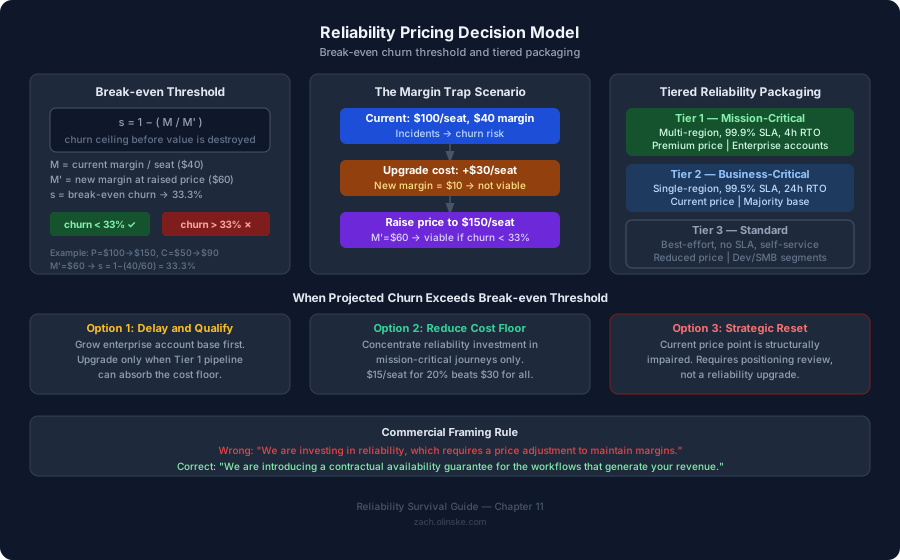
The scenario
A company sells a SaaS product at $100 per user per month. The gross margin on that seat is $40. Reliability incidents cause measurable churn. The engineering and finance teams agree that a meaningful reliability upgrade is required.
The upgrade costs $30 per seat per month to operate: additional redundancy, higher-tier provider commitments, observability tooling, on-call overhead, and chaos engineering capacity.
The math, at that point, is straightforward. The new margin is $40 minus $30, which equals $10. The product is no longer viable at current pricing.
The finance response is also straightforward: raise prices to $150 per seat. The new margin at $150 with $90 in costs is $60, which is healthier than the original $40.
The product and customer success response is less straightforward: a $50 price increase on a $100 product will trigger significant churn. The estimates cluster around 40 to 60 percent departure among price-sensitive segments.
The board question is then: which is more expensive, the churn from price sensitivity or the churn from continued unreliability?
That question has a numeric answer. Most organizations try to answer it from intuition. This chapter provides the framework to answer it from arithmetic.
The break-even churn threshold
Define the following variables:
P= current price per seat ($100)M= current margin per seat ($40)C'= new cost per seat after reliability upgrade ($90)P'= proposed new price per seat ($150)M'= new margin per seat at proposed price (P' - C'= $60)s= churn fraction after price increase (the unknown)n= current seat count
The business breaks even on the price increase when the retained margin equals the original margin:
(1 - s) × n × M' = n × M
(1 - s) × 60 = 40
1 - s = 40 / 60
s = 1 - 0.667 = 0.333
The break-even churn threshold is 33.3 percent.
If the price increase triggers less than 33 percent churn, the business is in a better position after the increase than before. If the increase triggers more than 33 percent churn, the price increase destroys more value than the reliability upgrade was meant to protect.
At the commonly estimated 50 percent churn level, the post-increase margin position is:
0.5 × n × 60 = 30nAgainst the original position of 40n, that is a 25 percent regression in total margin even after the upgrade succeeds. The business has paid for better reliability and ended up in worse economic shape.
This is the margin trap.
Model limitations
The break-even formula is directionally correct. It is not a forecast.
The model makes four simplifying assumptions that a CFO or VP Finance will challenge in any boardroom discussion.
First, it assumes linear pricing. Real SaaS revenue is rarely linear: enterprise discounts, multi-year commitments, and volume bands all change the effective per-seat margin. Run the formula against your blended effective margin, not your list price margin.
Second, it assumes uniform churn across the customer base. Churn is not uniform. Enterprise accounts, regulated customers, and customers with no viable alternative will exhibit very different elasticity from self-serve SMB accounts. A single aggregate churn estimate will systematically mislead the planning process. Model segments separately.
Third, it ignores customer acquisition cost. If the churned accounts must eventually be replaced, the cost of replacement partially offsets the margin improvement from the price increase. The formula becomes more conservative when CAC is added to the full-cycle analysis.
Fourth, it ignores lifetime value compression. High-churn cohorts may already have shorter expected tenure than your average LTV assumes. If price-sensitive customers were already at elevated churn risk from incidents, the incremental churn from the price increase may be smaller than a static model suggests.
Use this model to determine the right questions to ask, not to produce a number for the board deck without further grounding in your own customer data.
What the model reveals
Three insights follow directly from the break-even calculation.
First, the upgrade is not separable from the pricing strategy. Organizations that plan the reliability upgrade and the pricing conversation in different workstreams will often execute the upgrade correctly and fail at retention. The two plans must be developed in parallel from the beginning.
Second, the tolerance for churn varies by segment, not by average. A 33 percent break-even threshold at the aggregate level hides the fact that enterprise accounts may tolerate a $50 increase with minimal departure while SMB accounts depart entirely. A blended churn estimate is a poor planning input. The upgrade-and-pricing plan should model segment-level elasticity separately.
When the reliability model and the financial model disagree, the conflict is not resolved by picking a side. Chapter 4’s decision hierarchy applies directly: Tier 1 services resolve the conflict in favor of reliability over margin; Tier 2 services balance the two; Tier 3 services resolve in favor of margin. The pricing strategy must be aligned with the service tier composition of the customer base, not applied uniformly across it.
Third, the cost of the upgrade is not fixed. The $30 per seat figure in the opening scenario assumes a homogeneous reliability floor across the entire customer base. That assumption is almost always wrong. Tier 1 customers require full redundancy. Tier 3 customers would prefer a lower price over higher availability. A single-tier upgrade plan is both more expensive than necessary and less marketable than a segmented alternative.
The tiered reliability packaging model
The correct response to the margin trap is not a uniform price increase. It is a segmented offering that prices reliability as a differentiator rather than as an infrastructure tax.
Three tiers are sufficient for most SaaS products:
Tier 1 — Mission-critical: Full multi-region redundancy, committed 99.9 percent uptime SLA, 4-hour RTO, dedicated incident response. Price at a premium that reflects the full cost of delivery. Target customers are those for whom downtime is a regulatory, contractual, or reputational event.
Tier 2 — Business-critical: Single-region redundancy with failover, 99.5 percent uptime SLA, 24-hour RTO, standard incident path. Price at the current level or a modest increase. This is the baseline offer for the majority of the enterprise customer base.
Tier 3 — Standard: Best-effort availability, no committed SLA, self-service runbooks. Price at or below current, reflecting reduced operational overhead. Appropriate for development environments, early-stage companies, and price-sensitive segments unwilling to pay for the upgrade.
This structure allows the reliability investment to be concentrated where it generates the highest per-seat return, avoids subsidizing Tier 3 reliability costs, and creates a natural upsell path from Tier 3 to Tier 2 at the moment a customer has their first significant incident.
Price the journey, not the seat
The pricing model above still anchors to seat count. That is often the wrong unit.
Customers do not experience reliability at the seat level. They experience it at the customer journey level: the checkout flow, the report generation pipeline, the integration sync, the onboarding sequence. A single unreliable customer journey affects every user simultaneously regardless of seat count.
Seat-count pricing for reliability creates a misalignment: a 10-seat team with a mission-critical payment pipeline pays the same reliability premium as a 10-seat team with a low-stakes internal wiki. The payment pipeline team will pay. The wiki team will not.
Journey-based reliability pricing corrects this. Define the mission-critical journeys explicitly, as the Appendix SLI specification template describes. Price the availability guarantee against the expected financial exposure of those journeys failing, not against a headcount proxy.
This approach requires more customer-facing commercial work. It also generates significantly higher retention among customers whose business depends on specific high-value journeys, because the conversation shifts from “we are raising your price” to “we are now contractually protecting the part of your business that cannot afford to fail.”
Why the community conversation is incomplete
The engineering community has documented the cost of reliability at scale. Google’s Site Reliability Engineering book makes the nonlinear cost claim explicit: at five nines, the operational overhead consumes returns. AWS, Azure, and GCP all publish tiered SLA documentation.
What the community rarely addresses is the commercial conversion problem: what does the reliability investment produce in terms of pricing power and retention, not just infrastructure stability?
The closest public evidence includes:
- Atlassian’s incident management platform uses explicit SLA tier commitments to separate enterprise from SMB pricing
- OpenAI’s API pricing differentiates between standard and scale tier with explicit throughput guarantees
- DORA research establishes that high-performing delivery teams achieve lower change failure rates without sacrificing deployment frequency, suggesting reliability and speed are not inherently in tension
- Brendan Gregg’s public work on observability ROI has suggested 5 to 10 percent cost savings annually from effective profiling, but the revenue-side retention argument is absent from his writing
None of these sources address the break-even churn threshold directly. The formula in this chapter is an original model, not a citation. The community evidence provides supporting context for component assumptions. The model itself requires your organization’s own elasticity data to produce defensible numbers.
Mark this as requiring customer research before use in a board presentation.
The go-to-market narrative for reliability premiums
The commercial conversation for a reliability tier upgrade fails when it is framed as infrastructure cost recovery. It succeeds when it is framed as protected business outcomes.
The wrong framing: “We are investing in reliability, which requires a price adjustment to maintain our margins.”
The correct framing: “We are introducing a guaranteed availability commitment for the workflows that generate your revenue. Your current contract is best-effort. The new tier makes availability a commitment we are accountable for. Here is what that commitment is worth in terms of avoided downtime cost for your organization.”
The second framing requires that the sales and customer success teams can articulate the customer’s own downtime economics. That is a discovery process, not an assumption. Before the commercial conversation, the customer success team should be able to answer: what does one hour of downtime cost this customer in direct and indirect terms?
If the answer is materially larger than the annual premium increase, the conversation is straightforward. If the answer is unknown, the commercial conversation should not happen until the discovery work is complete.
The uncomfortable arithmetic
This chapter ends with the point most planning documents omit.
If the break-even churn threshold for the reliability upgrade is 33 percent, and the best available evidence suggests price-sensitive churn will reach 50 percent, the upgrade cannot be priced at the current scale. The business does not have the customer base composition required to absorb the cost increase.
There are three valid responses to that finding:
Delay and qualify: Do not raise the price until the customer base has a larger proportion of enterprise accounts for whom the premium tier represents genuine value. Invest in account growth before investing in the reliability upgrade.
Reduce the cost floor: Re-examine whether the $30 per seat upgrade cost is the minimum required for the tier population, or whether a segmented architecture with reliability concentrated in mission-critical journeys achieves acceptable outcomes at $15 per seat for 20 percent of customers.
Accept the strategic reset: If neither delay nor cost reduction is viable, the product economics at the current price point are structurally impaired. The correct response is not a reliability upgrade that accelerates margin destruction. It is a fundamental pricing and positioning review that may require a category move.
The wrong response is to proceed with the uniform upgrade at the original cost assumption and hope that churn comes in below the break-even threshold. Hope is not a financial model. In most organizations, the break-even threshold calculation takes a morning to build and prevents decisions that take quarters to undo.
What to do this quarter
Step 1: Calculate your break-even churn threshold. Use the formula from this chapter with your actual per-seat margin and the projected cost of the reliability upgrade. Produce a number. That number is the ceiling on price-increase-driven churn the business can absorb.
Step 2: Segment your customer base by journey criticality. Identify which customer segments have mission-critical journeys in your product. These are your Tier 1 candidates. Estimate their price elasticity separately from the SMB base. The aggregate blended estimate will mislead the planning process.
Step 3: Test one tiered offer. With legal and commercial approval, identify five to ten enterprise accounts where the mission-critical journey case is strong. Run a manual Tier 1 upgrade conversation with explicit SLA language and an honest cost basis. Measure acceptance rate and churn. This is the primary research the model requires.
Step 4: Sequence the upgrade against the customer mix. If the Tier 1 pipeline is not large enough to absorb the fixed reliability investment, delay the full upgrade and use the quarter to grow the enterprise account base. Reliability investment sequenced against customer base composition is disciplined. Reliability investment that forces a price increase the current book cannot sustain is a category error.
Key model
Break-even churn threshold: s = 1 - (M / M') where M is current margin per seat and M' is new margin per seat at the proposed price. If projected churn exceeds s, the price increase destroys more value than it recovers.
Chapter index
| Chapter | Topic |
|---|---|
| Chapter 1 | Opening thesis: reliability as economic decision |
| Chapter 2 | Incentives and organizational failure |
| Chapter 3 | Shared responsibility and accountability vacuum |
| Chapter 4 | The financial model |
| Chapter 5 | Provider failures and status page reality |
| Chapter 6 | Partial failures and degraded-state design |
| Chapter 7 | Hidden cost of observability tooling |
| Chapter 8 | Trade-offs: on-call, FinOps, and human cost |
| Chapter 9 | Governance system |
| Chapter 10 | Execution and the next quarter |
| Chapter 12 | Reliability pricing and the SaaS margin trap |
| Appendix | Operating artifacts and policy templates |
I work at Microsoft. The views expressed here are my own and based solely on publicly available information. This content is for educational purposes and does not represent official Microsoft guidance or commitments.